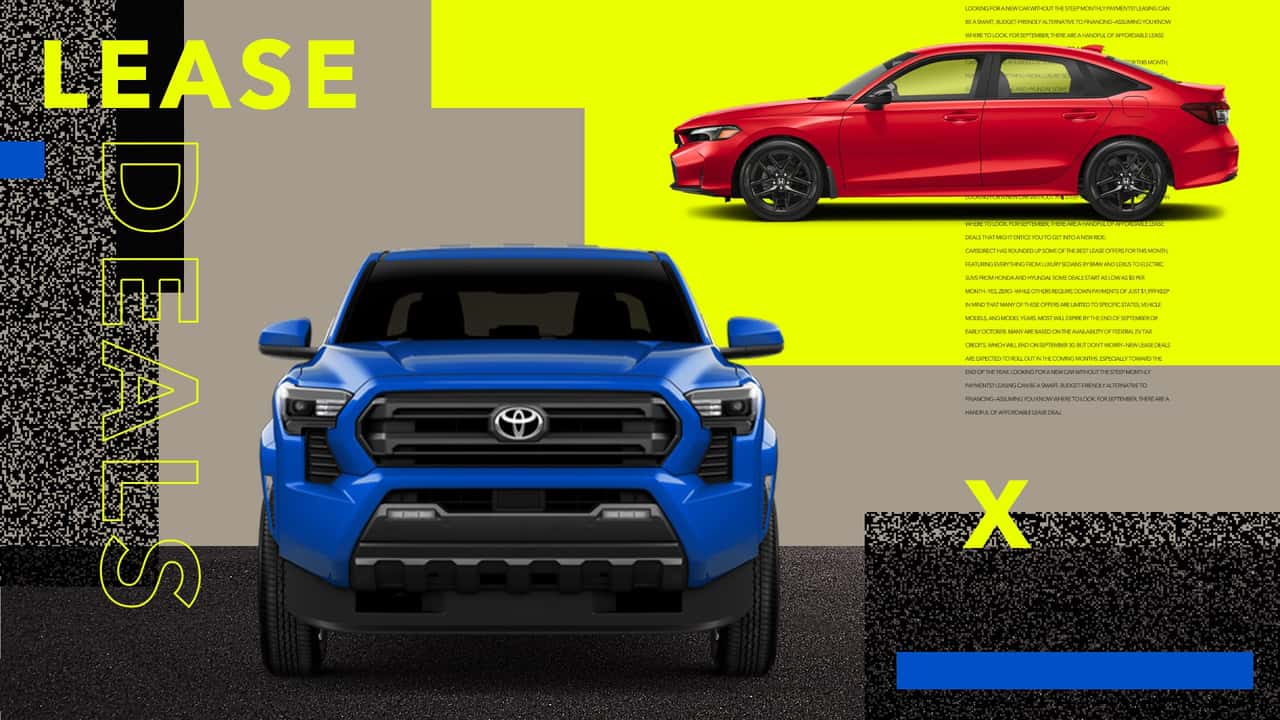
You can get a new Honda Civic for just $350 a month, or a Toyota Tacoma for less than $200.
Cars are expensive, and there aren’t many signs that prices will dip in the near future. That doesn’t mean you can’t still snag a great deal, especially if you’re okay with a lease. For November, there are some excellent, affordable options on the table.
CarsDirect has compiled a list containing a wide range of vehicle types—gas, electric, or hybrid—there’s something for everyone. And down payment options range from a few grand to as little as nothing. You can’t really get lower than that, that is, until someone starts a program to pay you to lease a car. When we uncover such a setup, we will report back.
For now, though, these lease deals listed below are the hot ticket items for November. Just keep in mind that pricing varies by state and region. Other deals may expire or change before you get to your local dealership.
If you’re shopping for a new car, the vehicles below are affordable options and should be on your list.
Zero dollars down for a new Civic is a heck of a deal. It’s part of Honda’s Sign & Drive event happening nationwide, and it also includes the first month’s lease payment as part of the deal. The $350 rate is for the Civic LX. But you could snag a Civic Sport Hybrid for just $30 per month.
That small jump equates to quite a bit more car—we’re talking 200 horsepower and 50 miles per gallon fuel economy.
The new 2026 Subaru Outback might be shipping already, but there are still deals to be found on the outgoing 2025 model. You’ll need to put a fair bit of cash down, but if you’re a past Subaru lessee, you qualify for a $500 discount. Your effective monthly cost can land as low as $359.
Be aware that current Subaru deals expire on December 1st. The deals also vary by region.
Honda Prologue deals keep on rolling. While the expired tax credit means EV pricing has risen a bit, you can find a Prologue EX for as little as $239 per month. The best lease rates for the Prologue are currently in Connecticut, Massachusetts, and Maryland. In other parts of the country, you can find a Prologue for $319 with $1,299 due at signing.
Ford wants to get you out of a Toyota and into a Blue Oval-brand product. The automaker offers $1,000 conquest cash incentive. The deal lowers the effective cost on a Bronco Sport Big Bend to just $345 per month.
Be aware that this incentive currently only exists for Southern California Ford shoppers. Check your regional deals for similar offerings.
Despite the EV tax credit disappearing, BMW offers $7,500 in lease cash for EV shoppers. You’ll need to bring $4,999 at signing, unless you qualify for the $2,000 loyalty discount—that drops you down to $2,999 due at signing.
Your effective monthly price will land at $482. This is a regional deal for California, and for i4 eDrive40 models.
A 2025 Lexus RX 350 requires $4,999 due at signing for a 36-month lease. This deal is currently available to West Coast customers only. But stay tuned, because the Lexus December to Remember sales event should be ramping into gear in short order.
Bring $3,999 at signing to step into a heck of a lease deal on the popular Toyota Tacoma. Just be mindful that this is a 24-month lease. The deal exists for Southern California shoppers, but it’s limited to lower trim, less powerful versions of the truck.
Current Toyota deals will end on December 1st.
Leasing a car allows you to drive a new vehicle with lower monthly payments compared to buying, often with minimal upfront costs and warranty coverage throughout the lease. It works by essentially renting the car for a set period—typically 24 to 36 months—during which you pay for the vehicle’s depreciation rather than its full value. There are two main types of leases: closed-end (you return the car with no further obligation if it’s in good condition) and open-end (you may owe for any difference between the car’s residual value and its actual market value). However, leasing has drawbacks, such as mileage limits, potential fees for wear and tear, and you don’t build equity since you don’t own the car.
Car leasing works like a long-term rental where you pay to use a vehicle for a fixed period, usually 2 to 4 years. Instead of paying for the full value of the car, you only pay for the depreciation that occurs during the lease term, plus interest and fees. You typically make an initial payment (called a down payment or capitalized cost reduction), followed by monthly payments. At the end of the lease, you can either return the car, buy it for a predetermined price (residual value), or lease a new one. Leases often come with mileage limits and require the car to be kept in good condition to avoid extra fees.
There are two main types of car leases: closed-end and open-end leases. A closed-end lease, the most common type for consumers, allows you to return the car at the end of the lease term with no further financial obligation, as long as you stay within mileage limits and maintain the vehicle’s condition. An open-end lease, often used for commercial purposes, requires you to pay the difference if the car’s market value is less than the estimated residual value at the end of the lease. Additionally, some leases may offer options like single-pay leases (paying the full lease amount upfront) or subvented leases (special deals offered by manufacturers with lower rates or incentives).
The typical term of a car lease ranges from 24 to 36 months, although some leases can be as short as 12 months or as long as 60 months. Most consumers opt for a lease term that aligns with the length of the manufacturer’s warranty to minimize out-of-pocket repair costs. Shorter leases offer more flexibility and allow you to drive newer cars more often, while longer leases usually come with lower monthly payments but may increase the risk of maintenance expenses as the vehicle ages.
The drawbacks of leasing a car include lack of ownership, meaning you don’t build equity in the vehicle and must return it at the end of the lease unless you choose to buy it. Leases also come with mileage limits, and exceeding them can result in costly fees. You may also face charges for excessive wear and tear, and ending a lease early can be expensive due to early termination penalties. Additionally, leasing can be more expensive in the long run if you continually lease rather than buy, since you’re always making payments without eventually owning an asset.
Check Out These Prices
We want your opinion!
What would you like to see on Motor1.com?
– The Motor1.com Team